

The anatomy of Search Engine Result Pages
The anatomy of Search Engine Results Pages
Every time you type something into Google, Bing, or DuckDuckGo, you land on a SERP — a Search Engine Results Page. But what looks like a simple list of blue links is actually a sophisticated, constantly evolving collection of result types. Understanding what appears on a SERP and why determines whether your business gets found or buried.
SERP Definition
A Search Engine Results Page (SERP) is the page a search engine displays in response to a user’s query. It’s not one-size-fits-all. The same search can produce wildly different results depending on:
- The specific words you typed
- Your physical location
- Your search history and past behavior
- Whether you’re on a phone, tablet, or desktop
Google dominates the SERP landscape, but Bing, Yahoo, DuckDuckGo, Baidu (China), and Yandex (Russia) each have their own layouts, ad placements, and unique result features. If your customers use Bing, optimizing only for Google misses them entirely.
The Anatomy of a Modern SERP
Gone are the days of ten blue links. Today’s SERP is a mosaic of result types, each competing for attention.
1. Organic Results
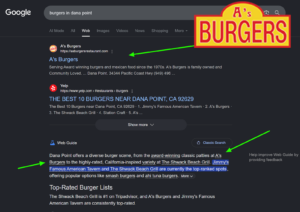
These are the classic non-paid listings ranked by the search engine’s algorithm. They’re the primary focus of SEO — you don’t pay for placement, you earn it through relevance, authority, and technical quality. For most businesses, organic traffic is the highest-ROI channel available.
2. Paid Advertisements
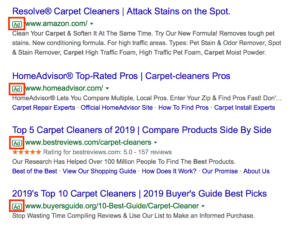
Pay-per-click (PPC) ads appear at the very top and bottom of the SERP, marked with a small “Sponsored” or “Ad” label. Advertisers bid on keywords and pay each time someone clicks. They’re effective for immediate visibility but stop the moment your budget runs out. Organic results, by contrast, compound over time.
3. Featured Snippets
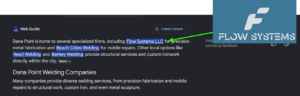
A featured snippet is a highlighted box at the top of the results that directly answers the search query. It pulls content from a webpage and displays it prominently — often called “position zero” because it sits above the #1 organic result. Google extracts these from pages with clear, structured answers to common questions. If you answer “what,” “how,” and “why” questions clearly on your site, you have a shot at this prime real estate.
4. Knowledge Panels
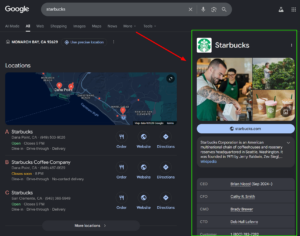
Knowledge panels are the information boxes that appear on the right side of the results (or at the top on mobile). They pull data from Google’s Knowledge Graph — a massive database of people, places, organizations, and facts. For a local business, having accurate, complete information across the web helps Google build a knowledge panel about your company. The more authoritative sources that reference your business, the richer that panel becomes.
5. Local Pack (The Map Results)
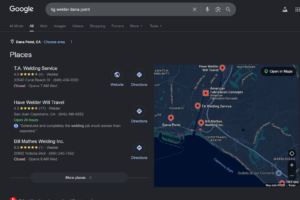
For queries with local intent — “plumber near me,” “best coffee shop in Irvine” — Google displays a map with three business listings. This is the local pack, and it’s arguably the most valuable SERP feature for small businesses. Each listing shows the business name, rating, address, hours, and phone number.
Appearing in the local pack requires:
- A verified Google Business Profile with complete, accurate information
- Consistent NAP (Name, Address, Phone) across the entire web
- Positive reviews, both in quantity and recency
- Local relevance signals from your website (location pages, embedded maps, Schema.org markup)
6. AI Overviews
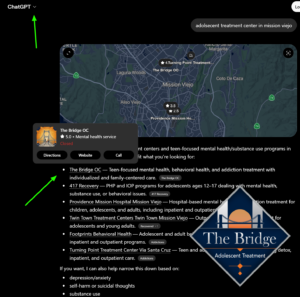
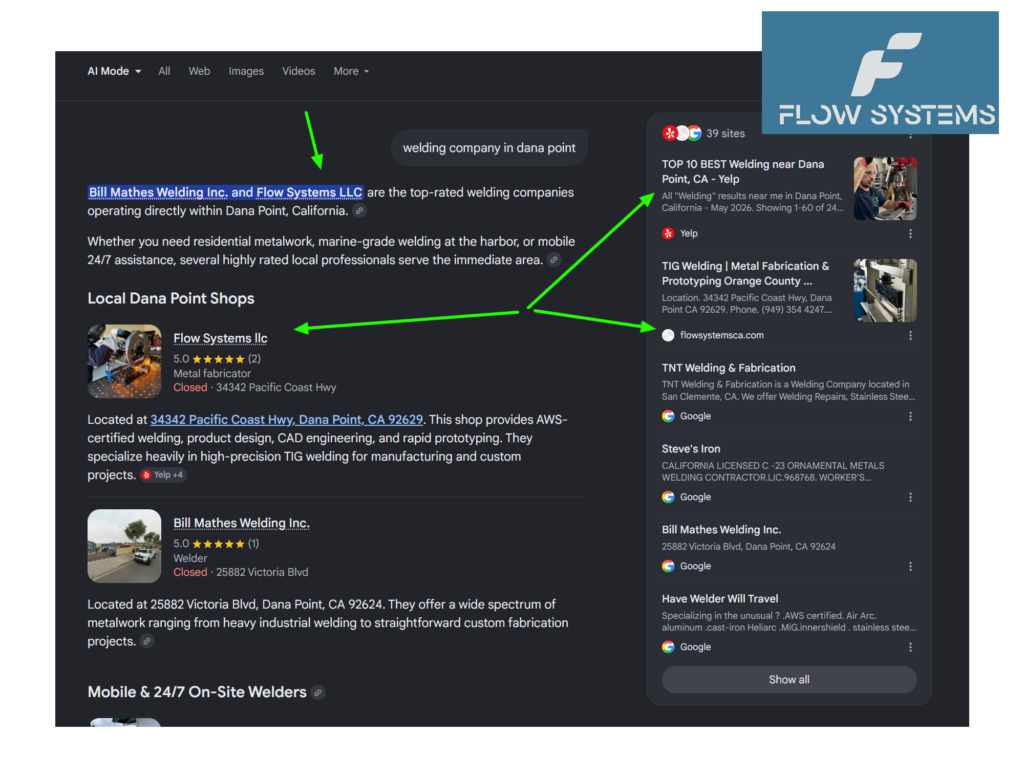
The newest and most disruptive addition. Google’s AI Overview generates an AI-written answer at the very top of the results, synthesizing information from multiple sources. It includes links and citations — but many users never scroll past it.
Bing has its own version through Copilot, and other search engines are racing to add similar features. This fundamentally changes SEO because:
- The AI answer occupies the most valuable screen space
- Citations don’t guarantee clicks — users get answers without leaving Google
- Only well-structured, authoritative content gets surfaced as a source
This is exactly why businesses need to optimize for AI Readiness — not just traditional SEO. If your site’s content isn’t structured in a way that AI can extract and understand, you won’t appear in AI-generated answers at all.
7. Other SERP Features
Modern results pages commonly include many other elements:
- Image packs — a horizontal row of images, often for product or visual queries
- Video results — YouTube embeds and other video sources
- “People also ask” — expandable question-and-answer accordions
- Shopping results — product listings with prices, ratings, and images
- Top stories — news carousels for timely queries
- Sitelinks — sub-pages shown below a main result for branded searches
- Twitter/X cards — embedded social media posts for real-time queries
Why This Matters for Your Business
The SERP is no longer a simple list — it’s a competitive arena where different result types fight for clicks. If you’re only optimizing for organic blue links, you’re invisible for AI overviews, local packs, knowledge panels, and featured snippets.
The businesses that win on today’s SERP are the ones that structure their data in a way that every result type can consume. That means Schema.org markup for rich results, FAQ content for snippets, consistent citations for local packs, and AI-friendly content formatting for AI overviews.
How We Help
At Internet Technology Services, we specialize in making businesses visible across every SERP feature — from the local map pack to AI-generated answers. Our AI-RO (AI Readiness & Optimization) scanner audits your site against 9 critical checks and shows you exactly where you’re invisible to search engines and AI assistants.
Is AI recommending your company or website?
Our tool will scan your site and provide you a free report to see if AI is capable of seeing your site
Free scan. Takes ~5 seconds. No credit card.
Running a local business in Orange County? You’re competing with companies that still think ten blue links is the whole game. Let’s make sure you’re seen everywhere your customers are looking.