
Be Seen
Why AI Recommendations Will Replace Traditional Search Engines

Ten years ago, the playbook for getting your business found was simple: rank high on Google. Today? The playbook is being rewritten. People aren’t just searching differently — they’re abandoning the search engine entirely.
Here’s the shift, the numbers behind it, and what it means for your business.
The Numbers Don’t Lie
If you think AI search is a fad, consider these data points from 2024-2025:
- 83% of users prefer AI-powered search tools over traditional search engines, according to a 2025 survey by Innovating with AI. That’s not a niche preference — it’s a landslide.
- Nearly 60% of Google searches now end without a single click to any website (SparkToro 2024 Zero-Click Study). The user gets their answer from Google’s own panels, snippets, and AI overviews — and never leaves.
- Only 36% of US Google searches result in a click to an actual website. The rest go to Google-owned properties, ads, or nowhere at all.
- ChatGPT hit 800 million weekly active users by April 2025 — doubling in just a few months.
- Perplexity AI grew 370% year-over-year in 2025, processing 780 million queries in a single month.
- 50% of Google searches already display AI-generated summaries at the top, and McKinsey projects that to exceed 75% by 2028.
- Half of consumers now intentionally seek out AI-powered search for purchase decisions (McKinsey 2025).
Google’s own CEO called 2025 a “critical” year for the company’s AI strategy. Internal discussions acknowledge the need to match what ChatGPT and Perplexity have already built. When the incumbent is scrambling, the market has spoken.
How AI Cuts Through the Noise That Search Engines Create
If you’ve used Google lately, you know the experience. Let’s be honest about what a typical search looks like today:
1. Ads, Then More Ads
Scroll past four paid advertisements before you see a single organic result. For competitive industries like insurance, legal services, or home repair, the entire first screen is sponsored. Google made $237 billion from ads in 2024 — and someone is paying for every one of those clicks.
2. Spam and Clickbait
SEO has become so industrialized that many top-ranking pages aren’t the best answer — they’re the best-optimized. AI-generated content farms churn out thousands of pages targeting the same keywords. The result? A race to the bottom where genuine expertise gets buried under SEO engineering.
3. Review Sites That Aren’t Reviews
The “best plumber in Irvine” search often returns pages from Yelp, Angi, Thumbtack, and HomeAdvisor — platforms that charge businesses for placement and take a cut of every lead. These aren’t objective reviews; they’re pay-to-play directories masquerading as consumer resources.
4. The Google Walled Garden
Featured snippets, knowledge panels, “People also ask” boxes, and AI Overviews all serve answers directly on the results page. Google is actively keeping users on Google. If your business relies on website traffic, you’re being walled out of your own customer relationships.
5. No Context, No Understanding
A search engine matches keywords, not meaning. Type “best way to fix a leaky faucet” into Google and you get a list of links. Type the same thing into ChatGPT and you get step-by-step instructions customized to your situation, with follow-ups you can ask immediately. One is a librarian pointing at shelves; the other is a plumber telling you what to do.
What AI Recommendations Do Differently
AI doesn’t rank pages — it answers questions. The difference is fundamental:
- One answer, not ten blue links. AI synthesizes information from multiple sources into a single, coherent response. No ads. No sponsored listings. No “Top 10 Best Plumbers (Which Pay Us).”
- Context matters. AI remembers what you just asked. You can say “how much should that cost?” and it knows you’re still talking about the leaky faucet. Search engines start from scratch every time.
- Follow-up is built in. Traditional search is one-and-done. AI is conversational. You refine, dig deeper, ask “why,” and get better answers with each exchange.
- Sources can be transparent. AI search tools like Perplexity and ChatGPT Search cite their sources. You can see where the information came from and judge its credibility — something Google’s AI Overviews have struggled with (remember the “add glue to pizza” incident?).
- No review hostage situation. AI recommendations draw from actual content across the web — not just the platforms that paid for the top spot on Google.
What This Means for Your Business
If your business depends on being found online, the ground is moving beneath you:
- Google traffic is shrinking. Zero-click searches, AI Overviews, and ChatGPT/Perplexity adoption are all pushing in the same direction — fewer people will visit your website through traditional search.
- AI can’t recommend what it can’t see. If your website doesn’t have structured data, clear service descriptions, FAQ content, and entity signals, AI assistants won’t surface your business — even if you rank #1 on Google.
- The window is now. Most small businesses haven’t adapted. Those who optimize for AI discoverability today will own the AI recommendation space before their competitors even realize the game changed.
Get Your Free AI Visibility Check
We built a tool that scans your website against 9 critical factors that AI assistants and search engines use to understand and recommend businesses. It takes about 5 seconds and shows you exactly where you’re invisible — and exactly how to fix it.
Check your AI visibility
Find out if AI is recommending your site with our free instant scan.
Free scan. Takes ~5 seconds. No credit card.
The search engine era isn’t ending tomorrow. But the businesses that ignore AI recommendations today are the ones wondering where their traffic went two years from now. Make sure AI can find you.
The anatomy of Search Engine Result Pages
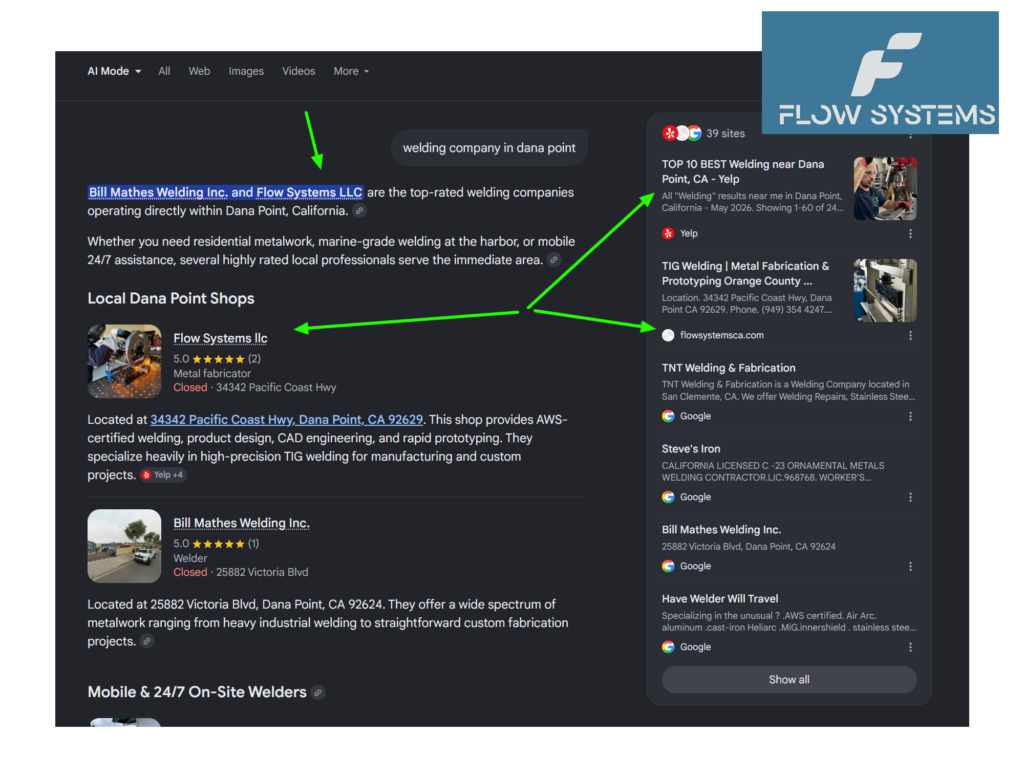
The anatomy of Search Engine Results Pages
Every time you type something into Google, Bing, or DuckDuckGo, you land on a SERP — a Search Engine Results Page. But what looks like a simple list of blue links is actually a sophisticated, constantly evolving collection of result types. Understanding what appears on a SERP and why determines whether your business gets found or buried.
SERP Definition
A Search Engine Results Page (SERP) is the page a search engine displays in response to a user’s query. It’s not one-size-fits-all. The same search can produce wildly different results depending on:
- The specific words you typed
- Your physical location
- Your search history and past behavior
- Whether you’re on a phone, tablet, or desktop
Google dominates the SERP landscape, but Bing, Yahoo, DuckDuckGo, Baidu (China), and Yandex (Russia) each have their own layouts, ad placements, and unique result features. If your customers use Bing, optimizing only for Google misses them entirely.
The Anatomy of a Modern SERP
Gone are the days of ten blue links. Today’s SERP is a mosaic of result types, each competing for attention.
1. Organic Results
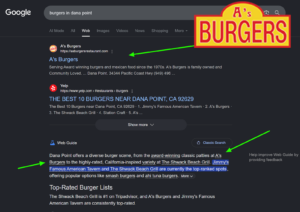
These are the classic non-paid listings ranked by the search engine’s algorithm. They’re the primary focus of SEO — you don’t pay for placement, you earn it through relevance, authority, and technical quality. For most businesses, organic traffic is the highest-ROI channel available.
2. Paid Advertisements
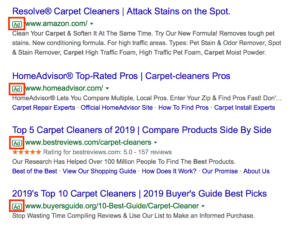
Pay-per-click (PPC) ads appear at the very top and bottom of the SERP, marked with a small “Sponsored” or “Ad” label. Advertisers bid on keywords and pay each time someone clicks. They’re effective for immediate visibility but stop the moment your budget runs out. Organic results, by contrast, compound over time.
3. Featured Snippets
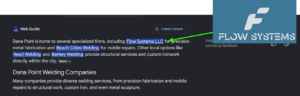
A featured snippet is a highlighted box at the top of the results that directly answers the search query. It pulls content from a webpage and displays it prominently — often called “position zero” because it sits above the #1 organic result. Google extracts these from pages with clear, structured answers to common questions. If you answer “what,” “how,” and “why” questions clearly on your site, you have a shot at this prime real estate.
4. Knowledge Panels
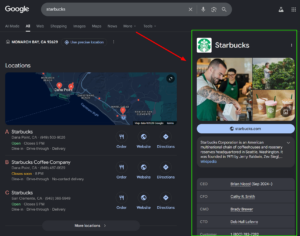
Knowledge panels are the information boxes that appear on the right side of the results (or at the top on mobile). They pull data from Google’s Knowledge Graph — a massive database of people, places, organizations, and facts. For a local business, having accurate, complete information across the web helps Google build a knowledge panel about your company. The more authoritative sources that reference your business, the richer that panel becomes.
5. Local Pack (The Map Results)
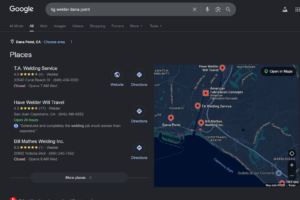
For queries with local intent — “plumber near me,” “best coffee shop in Irvine” — Google displays a map with three business listings. This is the local pack, and it’s arguably the most valuable SERP feature for small businesses. Each listing shows the business name, rating, address, hours, and phone number.
Appearing in the local pack requires:
- A verified Google Business Profile with complete, accurate information
- Consistent NAP (Name, Address, Phone) across the entire web
- Positive reviews, both in quantity and recency
- Local relevance signals from your website (location pages, embedded maps, Schema.org markup)
6. AI Overviews
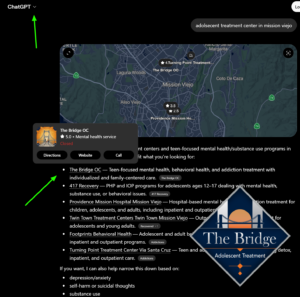
The newest and most disruptive addition. Google’s AI Overview generates an AI-written answer at the very top of the results, synthesizing information from multiple sources. It includes links and citations — but many users never scroll past it.
Bing has its own version through Copilot, and other search engines are racing to add similar features. This fundamentally changes SEO because:
- The AI answer occupies the most valuable screen space
- Citations don’t guarantee clicks — users get answers without leaving Google
- Only well-structured, authoritative content gets surfaced as a source
This is exactly why businesses need to optimize for AI Readiness — not just traditional SEO. If your site’s content isn’t structured in a way that AI can extract and understand, you won’t appear in AI-generated answers at all.
7. Other SERP Features
Modern results pages commonly include many other elements:
- Image packs — a horizontal row of images, often for product or visual queries
- Video results — YouTube embeds and other video sources
- “People also ask” — expandable question-and-answer accordions
- Shopping results — product listings with prices, ratings, and images
- Top stories — news carousels for timely queries
- Sitelinks — sub-pages shown below a main result for branded searches
- Twitter/X cards — embedded social media posts for real-time queries
Why This Matters for Your Business
The SERP is no longer a simple list — it’s a competitive arena where different result types fight for clicks. If you’re only optimizing for organic blue links, you’re invisible for AI overviews, local packs, knowledge panels, and featured snippets.
The businesses that win on today’s SERP are the ones that structure their data in a way that every result type can consume. That means Schema.org markup for rich results, FAQ content for snippets, consistent citations for local packs, and AI-friendly content formatting for AI overviews.
How We Help
At Internet Technology Services, we specialize in making businesses visible across every SERP feature — from the local map pack to AI-generated answers. Our AI-RO (AI Readiness & Optimization) scanner audits your site against 9 critical checks and shows you exactly where you’re invisible to search engines and AI assistants.
Check your AI visibility
Find out if AI is recommending your site with our free instant scan.
Free scan. Takes ~5 seconds. No credit card.
Running a local business in Orange County? You’re competing with companies that still think ten blue links is the whole game. Let’s make sure you’re seen everywhere your customers are looking.
WordPress SEO Best Practices: Boost Your Business Visibility


If your company relies on WordPress, you’re already making a smart choice. But are you truly maximizing your site’s reach? In the current digital landscape, SEO is more than just industry jargon—it’s essential for connecting with your ideal customers. Whether you’re developing applications, utilizing artificial intelligence, or expanding through cloud solutions, your WordPress platform should stand out in search engine results.
Here’s a straightforward guide to help your business rise above the noise.
1. Build on a Strong Base
Before diving into optimization, ensure your WordPress installation is solid. Select a trustworthy hosting service. Quick, secure hosting not only satisfies search engines but also keeps your audience engaged. If you need assistance with tailored themes, plugins, or ongoing site management, our WordPress Development Services can position you for long-term success.
2. Choose SEO-Optimized Themes and Plugins
Themes aren’t all created equal. Opt for one that’s streamlined, mobile-friendly, and built with SEO best practices. Steer clear of bulky designs—they can drag down your site’s speed and rankings.
Add a reputable SEO plugin such as Yoast SEO or Rank Math. These tools walk you through optimizing each page, from meta information to sitemaps. Think of them as your behind-the-scenes SEO partner—no superhero costume required.
3. Prioritize Site Performance
Site speed is crucial. Both Google and your visitors expect quick load times. Compress your images, enable browser caching, and reduce unnecessary CSS or JavaScript files. If your site handles demanding applications or requires flexible infrastructure, our Cloud Services can help ensure your site remains fast and reliable.
4. Develop High-Quality, Searchable Content
Content remains at the heart of SEO, but relevance is just as important. Research the keywords your audience is actually using. Weave these terms naturally into your headlines, subheadings, and main text. Avoid overusing keywords—search engines (and people) will notice.
Always write with your readers in mind first, and optimize for search engines second. If your offerings include Mobile Application Development or Web Application Development, produce content that addresses real needs and highlights your expertise.
5. Organize Your Website Effectively
A well-structured website benefits both visitors and search engines. Use clear categories, relevant tags, and thoughtful internal links. Your homepage should direct users to your main services, while each service page should connect to related blog articles or case studies.
Breadcrumb navigation isn’t just a fairy tale concept—it helps both users and Google understand your site’s layout. Most SEO plugins make adding breadcrumbs simple.
6. Fine-Tune Titles and Meta Descriptions
Each page deserves its own unique title and meta description. These elements serve as your introduction in search listings—make them engaging. Incorporate your target keywords in a way that feels natural. Treat meta descriptions like a quick sales pitch: brief, persuasive, and to the point.
7. Ensure Mobile Responsiveness
With the majority of web traffic now coming from smartphones and tablets, a mobile-friendly site is non-negotiable. Test your website on different devices to guarantee a seamless experience. If you need expert help creating mobile-ready solutions, our Mobile Application Development team is ready to assist.
8. Implement Schema Markup
Schema markup allows search engines to better interpret your content. This can enhance your listings with rich snippets—such as ratings, FAQs, or event details. Many SEO plugins offer straightforward schema integration. Think of it as giving search engines a helpful guide to your site.
9. Keep Your Site Secure
Having a secure (HTTPS) website is now a ranking factor. Set up an SSL certificate and keep your WordPress core, plugins, and themes up to date. Security isn’t just about SEO—it builds trust with your visitors.
10. Track Progress and Refine Your Approach
SEO is an ongoing process. Use tools like Google Analytics and Search Console to monitor your site’s performance. Identify what’s effective and where there’s room for improvement. If you’d like a professional review of your SEO efforts, our Search Engine Optimization Services can help you reach higher rankings.
Bonus: Harness the Power of AI and Automation
Looking to push your SEO further? AI-driven tools can help with keyword analysis, content suggestions, and automating repetitive tasks. If you’re interested in custom AI integrations, explore our Custom Conversational AI Agents to enhance engagement and streamline your operations.
Wrapping Up
Mastering WordPress SEO doesn’t require a degree in rocket science—but it does demand attention and adaptability. By following these strategies, you’ll increase your business’s visibility, attract more qualified prospects, and maintain a competitive edge.
Ready to take your WordPress site to the next level? Whether you need help with development, SEO, cloud solutions, or AI integration, Internet Technology Services is here to support your growth.
Why AI-Driven SEO Strategies Are Crucial for Staying Ahead

In today’s rapidly evolving digital landscape, maintaining a competitive edge is akin to running on a treadmill—constant movement is necessary to avoid falling behind. The secret weapon in this race? AI-driven SEO strategies. These tools have transitioned from being a luxury to a necessity for securing a competitive advantage.
The Influence of AI on SEO
AI is revolutionizing SEO, transforming it from an art into a precise science. Picture having an ultra-intelligent assistant that never rests, continuously evaluating data and trends to enhance your online presence. AI can process enormous volumes of information at incredible speeds, offering insights that might elude human analysts.
Consider the daunting task of manually sifting through countless search queries to detect patterns. Exhausting, isn’t it? AI accomplishes this in mere seconds, identifying trends, forecasting changes, and recommending strategies to keep your content pertinent and visible.
Targeting with Precision
AI-driven SEO facilitates precision targeting, akin to having a GPS for your marketing initiatives. By analyzing user behavior, demographics, and preferences, AI tailors content that hits the target precisely. This results in higher engagement rates and improved conversion.
For enterprises seeking app development, cloud, SEO, or AI integration services, precision targeting is vital. It ensures your message reaches the appropriate audience at the optimal time. At Internet Technology Services, our SEO services harness AI to amplify your digital presence and drive growth.
Optimizing Content
While content remains king, even monarchs require assistance. AI tools can optimize content for search engines by suggesting keywords, enhancing readability, and even generating content ideas. It’s like having a creative partner who knows exactly what your audience desires.
For example, if you’re involved in WordPress development, AI can aid in crafting content that resonates with potential clients seeking custom themes or plugins. Need support with WordPress? Explore our WordPress Development Services.
Predictive Analytics
AI doesn’t merely react; it anticipates. It’s like possessing a crystal ball that helps you foresee market trends and adjust your strategies accordingly. Predictive analytics can forecast changes in search algorithms, allowing you to stay ahead.
This is especially beneficial for businesses in the cloud services sector. With AI, you can predict demand, optimize resources, and ensure seamless service delivery. Interested in cloud solutions? Our Cloud Services have you covered.
Enhancing User Experience
AI-driven SEO enhances user experience by personalizing interactions. It’s like having a concierge who knows your preferences and anticipates your needs. AI can analyze user data to deliver personalized content and recommendations, boosting engagement and satisfaction.
For businesses offering mobile application development, this is transformative. Personalized user experiences can significantly increase app retention rates. Need an app that stands out? Discover our Mobile Application Development services.
Insights in Real-Time
In the digital era, real-time insights are invaluable. AI provides up-to-the-minute data on user behavior, search trends, and competitor strategies. It’s like having a live feed of the digital landscape, enabling you to make informed decisions swiftly.
For those in web application development, real-time insights can guide design and functionality improvements, ensuring your applications meet user expectations. Looking to develop a cutting-edge web app? Our Web Application Development services can assist.
Automation and Efficiency
AI automates repetitive SEO tasks, freeing up time for strategic planning. It’s like having a robotic assistant handling the tedious work, allowing you to focus on the broader picture. Automation boosts efficiency and minimizes the risk of human error.
For businesses integrating conversational AI agents, automation is crucial. AI can manage customer interactions, delivering quick and accurate responses. Interested in enhancing customer engagement? Check out our Custom Conversational AI Agents.
Conclusion
AI-driven SEO strategies have become indispensable for maintaining a competitive edge. They offer precision, optimization, predictive insights, enhanced user experiences, real-time data, and automation. In a world where digital presence is paramount, AI is the key to staying ahead.
Whether you’re developing apps, managing cloud services, or enhancing your SEO, embracing AI is the path forward. Ready to make the leap? Let Internet Technology Services guide you on your journey to digital excellence.
5 Strategies to Boost Your Content Marketing ROI with AI

In the ever-evolving landscape of digital marketing, maintaining a competitive edge is essential. Enter Artificial Intelligence (AI) – the transformative force you may not have realized you needed. AI has the potential to elevate your content marketing initiatives, enhancing their efficiency, precision, and profitability. Here are five strategies through which AI can amplify your content marketing ROI.
1. Mass Personalization
AI possesses the capability to sift through enormous datasets to discern customer behaviors and preferences. This enables you to deliver tailored content to your audience on a grand scale. Envision consistently sending the perfect message to the right individual at the optimal moment. It’s akin to providing each customer with a personal assistant, sans the awkward pleasantries.
With AI, audience segmentation becomes more precise, allowing you to customize your content to align with specific needs. This degree of personalization can significantly enhance engagement and conversion metrics.
2. Content Generation and Selection
AI extends beyond mere data analysis; it can also assist in content creation. AI-driven tools are capable of generating blog articles, social media content, and even video scripts. While they won’t replace your creative team, they can certainly ease their workload.
Additionally, AI can curate content by navigating vast amounts of information to identify the most pertinent and trending topics. This ensures your content remains fresh and captivating, encouraging your audience to return for more.
3. SEO Enhancement
Search Engine Optimization (SEO) is crucial for attracting visitors to your website. AI can elevate your SEO strategy by examining search behaviors and forecasting future trends. This allows you to optimize your content for keywords that are not only relevant today but will also be sought after in the future.
Our Search Engine Optimization Services can assist you in leveraging AI to improve your search rankings and increase organic traffic to your site. After all, if your content isn’t on Google’s first page, does it really exist?
4. Predictive Insights
Predictive analytics offers a glimpse into the future of your marketing endeavors. AI can scrutinize historical data to forecast future results, aiding you in making informed decisions about your content strategy. Curious about which content type will excel next quarter? AI has the answers.
By identifying what succeeds and what falls short, you can allocate resources more judiciously, ensuring maximum return on investment.
5. Improved Customer Interaction
AI can enhance customer interaction through chatbots and conversational interfaces. These tools deliver immediate responses to customer inquiries, enhancing user experience and fostering brand loyalty. Plus, they never require a coffee break.
If you aim to elevate customer interaction, explore our Custom Conversational AI Agents. They function like your customer service team, but with round-the-clock availability and zero attitude.
Conclusion
AI transcends being a mere buzzword; it is a potent instrument capable of revolutionizing your content marketing approach. From personalization and content generation to SEO and predictive insights, AI can help you achieve a superior ROI. Ready to incorporate AI into your marketing strategies? Whether you require WordPress Development Services, Cloud Services, or Mobile Application Development, we are here to assist.
Embrace the future of content marketing with AI, and watch your ROI soar. In the realm of digital marketing, being ahead of the curve is invaluable.
Beyond Keywords: Using AI SEO Tools for Semantic Search Optimization
Semantic Search: Why Your Keyword List Needs an AI Sidekick
Remember the good old days of SEO? Stuff a keyword in the title, sprinkle it generously throughout the text (maybe even hide some in white text on a white background – shhh!), and voilà! Rankings galore.
Okay, maybe it wasn’t that simple, but keyword density used to be king.
Those days are long gone.
Search engines, now powered by sophisticated Artificial Intelligence (AI), understand language much like humans do. They grasp context, infer intent, and recognize the subtle relationships between words and concepts. This is the era of semantic search.
Sticking solely to outdated keyword-stuffing tactics is like trying to navigate a modern bustling city with a map from the 1800s. You might stumble upon something, but it’s highly unlikely to be precisely what you were looking for.
What Exactly is Semantic Search?
Think of it this way:
You submit a search query like “best apple pie recipe.”
Old SEO approaches would primarily focus on matching the exact words: “best,” “apple,” “pie,” “recipe.”
Semantic search, however, understands the underlying user need and connects related concepts. It understands you are looking for:
- Instructions on how to bake.
- Ingredients typically involved (apples, flour, sugar, cinnamon).
- Highly-rated or popular variations of the recipe.
- Perhaps even variations like vegan or gluten-free options.
Semantic search connects these concepts. It understands the why behind your search query. It’s less about simply matching exact strings of text and significantly more about matching the intended meaning. Google’s ultimate goal is to deeply understand the intent behind a user’s query, not just the specific keywords they used.
Why Your Keyword List Isn’t Sufficient Anymore
Let’s be clear: traditional keyword research is still an important component of SEO strategy. However, focusing only on specific, isolated keywords misses the much larger and more critical picture in the age of semantic search.
- Synonyms & Variations: People phrase their searches in countless different ways. AI helps Google understand that phrases like “cloud computing services,” “cloud infrastructure management,” and “online server hosting” can all relate to the same fundamental user need for cloud solutions.
- Context Matters: The meaning of a word like “Java” changes drastically depending on whether the surrounding text is discussing coffee, computer programming, or a geographical island. Semantic search is designed to discern this crucial context.
- User Intent: Is the searcher primarily looking to learn something (informational intent), make a purchase (transactional intent), find a specific website (navigational intent), or compare different options (commercial investigation intent)? Your content must align precisely with this underlying intent. Trying to push a hard sale in response to a purely informational query simply won’t be effective.
Ignoring the principles of semantic search means you are highly likely to miss out on valuable organic traffic from users whose queries may not perfectly match your predefined target keywords, but whose intent aligns perfectly with the products or services you offer.
Welcome Your AI SEO Sidekick
This is precisely where AI-powered SEO tools become incredibly valuable. They move beyond basic keyword tracking and analysis to examine content and search trends through a sophisticated semantic lens. Think of these tools as your translators, helping you effectively communicate in Google’s increasingly nuanced and human-like language.
These advanced tools leverage machine learning algorithms and Natural Language Processing (NLP) – the same core technologies that power sophisticated chatbots and virtual assistants – to understand online content much like a human would (albeit a very fast, data-driven, and analytical human).
How AI Tools Enhance Semantic Optimization
AI SEO tools are far more than just fancy keyword finders. They offer deep, actionable insights that drive semantic optimization:
- Topic Cluster Analysis: AI analyzes vast amounts of data to identify the main topics and related subtopics you should comprehensively cover to demonstrate authority and expertise in your niche. This helps you structure your content logically around themes, creating comprehensive resources that fully satisfy user intent. A well-organized website structure, perhaps built on flexible platforms like WordPress, makes implementing these topic clusters significantly easier. Need expert assistance in structuring your WordPress site for optimal semantic SEO? Explore our WordPress Development Services.
- Content Gap Identification (Semantically!): Instead of simply seeing which specific keywords your competitors rank for, AI tools analyze the broader topics and the semantic structure of their content. This reveals conceptual gaps in your content strategy, highlighting areas where you can create content that provides more value, depth, and context to your audience.
- User Intent Analysis: AI algorithms are capable of analyzing search queries alongside the content that currently ranks highest for those queries to infer the most probable intent behind them. This crucial insight allows you to tailor your landing pages, specific app features, or blog posts to precisely match what the user is trying to achieve. Understanding user intent is critical regardless of whether you’re developing a helpful Web Application or designing an engaging Mobile Application.
- NLP-Powered Content Optimization: These tools analyze your written text for semantic relevance, readability, and even sentiment. They suggest related terms, concepts, and phrases (going beyond just exact-match keywords) to include, helping you create richer, more contextually relevant content that resonates deeply with both human readers and AI-powered search engines. This same advanced NLP understanding is fundamental to powering effective, human-like customer interactions. Interested in leveraging this technology for your business? Explore our services for Custom Conversational AI Agents.
- Schema Markup Assistance: Structured data, often using Schema.org vocabulary, explicitly tells search engines what specific type of content you have (e.g., “this is a recipe,” “this is an event listing,” “this is a product page”). Some advanced AI tools can analyze your content and suggest or even help generate the appropriate Schema markup. This significantly improves how search engines understand the context and meaning of your information, potentially leading to richer search result snippets. Ensuring your underlying website infrastructure, which might be managed via reliable Cloud Services, is configured to handle structured data smoothly is also a key technical consideration.
Practical Steps for Implementing Semantic SEO
- Think in Terms of Topics and Themes, Not Just Isolated Keywords: Plan your content strategy around broader subjects and delve into related questions and subtopics comprehensively within each piece.
- Prioritize User Intent: Always ask yourself why someone is searching for a particular term. Create content that directly addresses their underlying need or goal.
- Write Naturally and Conversationally: Use a variety of synonyms, related terms, and natural language. Your primary audience is humans; the AI-powered search engines are sophisticated enough to understand well-written content. Avoid awkward keyword stuffing at all costs.
- Structure Your Content Logically: Use clear, descriptive headings (H2s, H3s) and break up large blocks of text with shorter paragraphs and bullet points. Make information easy for users to scan and digest.
- Leverage AI Tools Strategically: Utilize AI-powered SEO tools for research, in-depth analysis, and optimization suggestions, but always apply human oversight and critical thinking. They are powerful assistants, not autonomous decision-makers for your content strategy.
The Indispensable Human Touch
While AI tools are incredibly powerful assistants, they are not and cannot replace human strategy, creativity, and empathy. They provide data, analysis, and suggestions; you provide the authentic brand voice, the unique insights derived from your experience, and the deep understanding of your specific target audience’s needs and desires.
AI might tell you what topics are semantically relevant, but how you choose to cover them – your unique perspective, real-world examples, storytelling, and genuine connection with the reader – that remains a uniquely human contribution. (And let’s be honest, AI hasn’t quite mastered witty banter or genuine emotional resonance… at least not yet!)
Moving Beyond Outdated Keyword Strategies
Semantic search is not just the future; it is the current reality of SEO. By strategically embracing AI-powered tools and approaches, you can move beyond outdated, simplistic keyword tactics and focus on what genuinely matters in the digital age: creating highly valuable, comprehensive, and contextually rich content that meets user intent directly and effectively.
This modern approach not only leads to improved search engine rankings but also helps you build authority in your niche, deeply engage your target audience, and ultimately drive better, more sustainable business results – regardless of whether your focus is on developing the next innovative web application, managing complex cloud infrastructures, or integrating cutting-edge AI solutions.
Feeling ready to optimize your content for the semantic web but unsure of where to begin or how to best leverage AI? Our expert team is here to help you navigate the complexities of modern digital marketing and search optimization. Explore our Search Engine Optimization Services to learn how we can assist you.