
Artificial Intelligence
IDR AI Insights
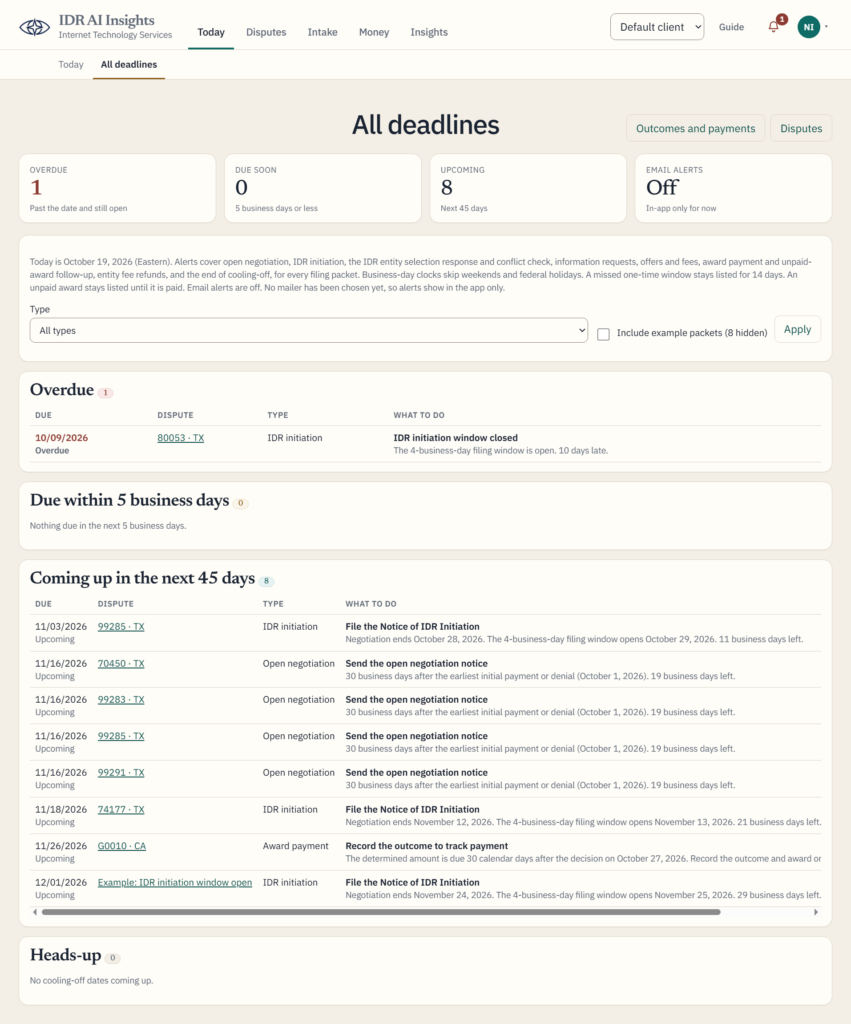
Today we’re introducing IDR Insight AI, a new tool from Internet Technology Services (ITS) for the federal Independent Dispute Resolution (IDR) process under the No Surprises Act. It helps providers, billing companies and their reps prepare, file and manage out-of-network payment disputes with health plans, faster and with fewer costly mistakes.
IDR Insight AI brings the latest AI technology to the IDR industry, backed by the engineering experience we’ve built since 2009 across more than 100 client projects from our base in Dana Point, California. We’re now preparing a pilot program with a small group of providers, and this post explains what we built, why, and how to get involved.
The current market
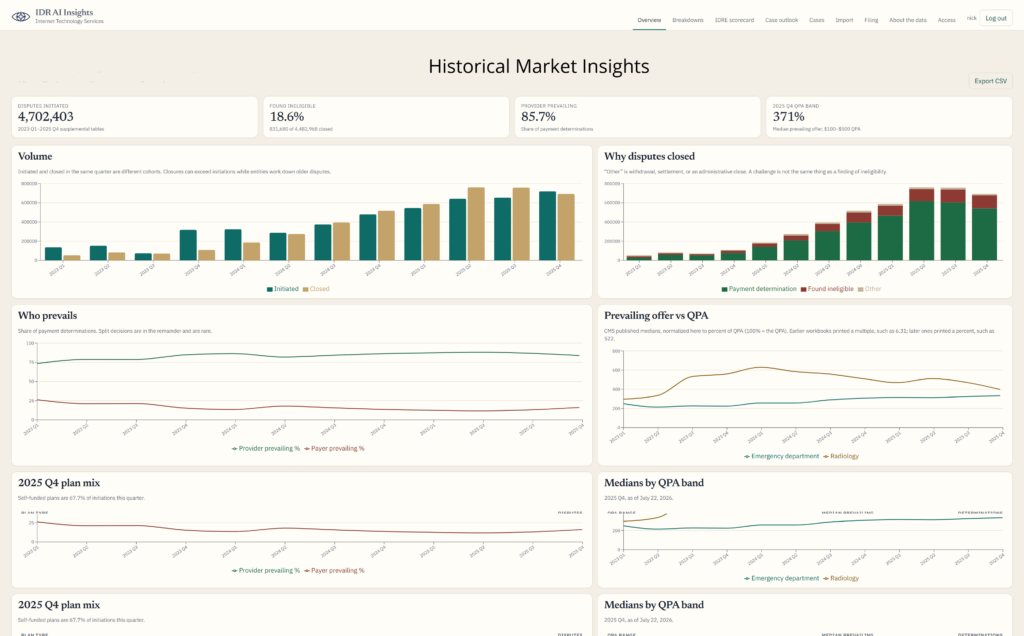
When the federal IDR process launched in April 2022, the Departments of Health and Human Services, Labor and the Treasury expected about 22,000 disputes in its first year. By June 2023 they had received nearly 490,000, according to the U.S. Government Accountability Office.
The volume never slowed. As of July 31, 2026, more than 7 million disputes had been initiated since the portal opened, including 2,145,850 in the first seven months of 2026 alone (CMS IDR reports).
Providers win most of the disputes that reach a decision. In the second half of 2025, providers, facilities and air ambulance providers prevailed in about 85% of payment determinations, and the prevailing offer was higher than the qualifying payment amount (QPA) in about 87% of them (CMS).
Where the market is heading
Volume is still climbing. Georgetown’s Center on Health Insurance Reforms (CHIR) reports that disputes rose 77% from 2024 to 2025 to 2.6 million, and that the first six months of 2026 reached 1.75 million, 50% above the same period of 2025 (Georgetown CHIR). CMS counted 394,140 disputes initiated in July 2026 alone, up 24% from June (CMS).
The rules are changing too. A federal IDR operations final rule published June 4, 2026 cut the administrative fee from $115 to $15 per party per dispute for disputes initiated on or after June 11, 2026. The cut is expected to make the process more accessible to smaller providers and facilities, and the Departments anticipate it may increase dispute volume. The same rule formalizes open negotiation notices, adds a hard cap of 50 items per batched dispute with a new “similar condition” batching test for open negotiations starting on or after November 1, 2026, creates a registry for plans and issuers, and requires standardized remittance codes that show whether a claim is subject to the No Surprises Act (Holland & Hart summary).
Costs are drawing scrutiny. The CHIR study estimates the IDR system cost $22.4 billion from 2022 to 2025, including $16.6 billion in 2025 alone, and notes renewed attention from policymakers (Georgetown CHIR; Medical Economics). The takeaway for providers: more disputes, new paperwork requirements and closer scrutiny all reward filings that are accurate, complete and on time.
The demand that isn’t being met
Eligibility is still the biggest stumbling block. Non-initiating parties challenged the eligibility of 42% of disputes in the second half of 2025, and about 19% were found ineligible, most often because of an unfinished 90-day cooling-off period or because the dispute belonged in a state process (CMS). Since April 2022, more than 1.16 million disputes have been closed as ineligible (CMS).
The process is also dominated by a few large players. The top ten initiating parties filed about 66% of disputes in late 2025 (CMS), and CHIR found that many smaller local practices aren’t using IDR at all. One of the study’s authors said navigating it takes resources most small practices lack, including familiarity with the federal portal (Medical Economics).
Labor is the hidden cost. The federal departments estimated plans’ and providers’ internal costs to submit IDR materials at $857 per dispute (Georgetown CHIR), and one software competitor puts manual filing at 25–40 minutes per claim (Sydra). With the administrative fee now just $15, staff time is the main thing keeping smaller providers on the sidelines.
How IDR Insight AI is different
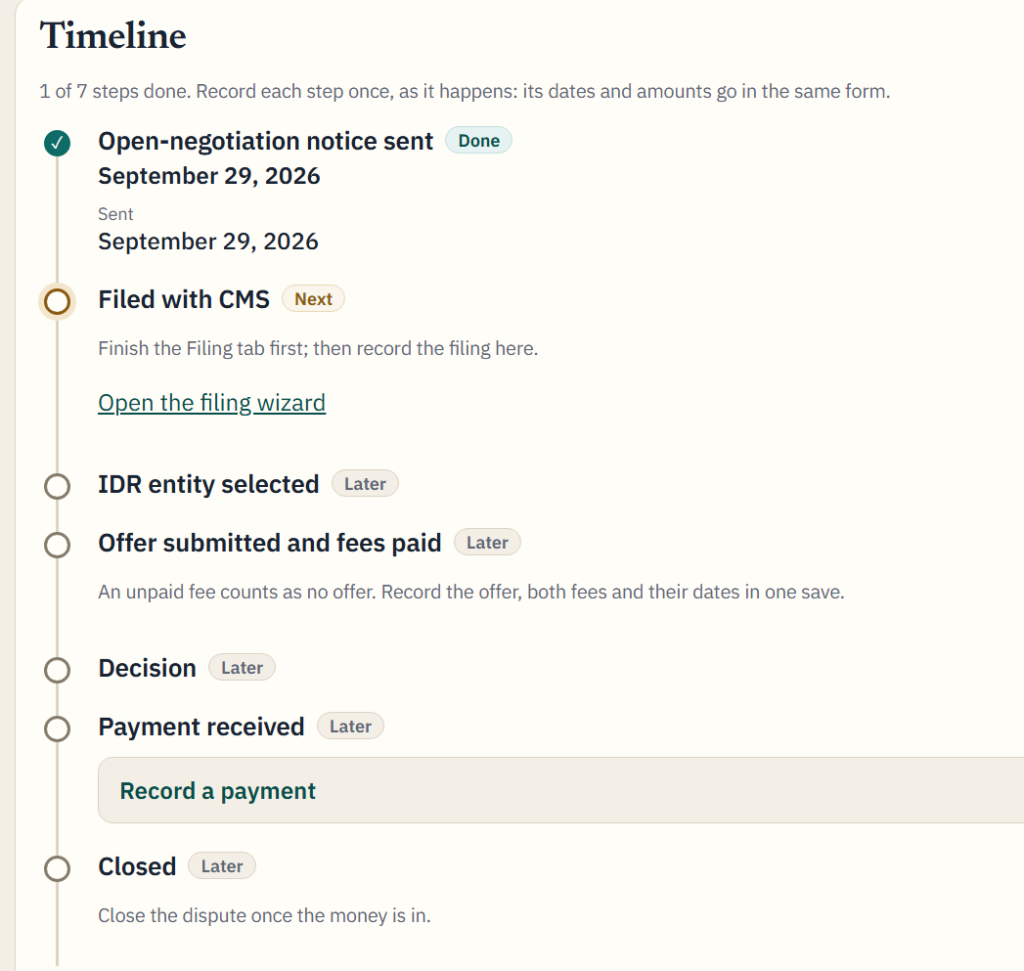
IDR Insight AI was purpose-built for one job: getting federal IDR disputes right. It combines the latest AI technology with rule logic written specifically for the IDR process, and it works from your data rather than generic boilerplate.
- Fast AI judgment calls before you file. IDR Insight AI reviews each dispute for likely eligibility, the right service and code category, and missing evidence. Anything it isn’t confident about is flagged for human review instead of guessed at.
- Probability-based signals, not hunches. See how likely a dispute is to be worth filing, and where an offer sits relative to the QPA compared with how similar disputes have actually been decided.
- Arguments built from your case, not a template. Draft positions are assembled from your own case details and public CMS outcome data, so every packet reflects the actual dispute.
- Hard rules stay hard. Deadlines, batch limits, duplicate checks and out-of-scope services are decided by fixed rule logic, not left to interpretation.

The pricing model is different, too. Much of the outsourced IDR help on the market charges a contingency: a percentage of whatever extra you recover. Published rates range from 10% of the improvement over the payer’s initial offer (Claims Assassins) to “20 percent or more” as described by one software competitor (Sydra). In a services agreement filed with the SEC, HaloMD, one of the largest IDR filers, charged a client 20% of the net recovery on federal IDR awards, while the client still paid the IDR entity and CMS administrative fees up front (SEC filing). A June 2026 amendment lowered that to 16% for awards issued on or after July 1, 2026 (amendment).
Using the worked example in that agreement (written for a state arbitration claim, but the math is the same), a $2,000 award less a $100 initial payment, $100 patient responsibility and a $115 administrative fee leaves a $1,685 net recovery. At 20%, the firm’s fee is $337. At 16%, it’s $269.60 (SEC filing). Across 100 similar wins, that’s $26,960 to $33,700, and it grows with every dollar you win. Government fees, by contrast, are modest: the $15 administrative fee per party, and a certified IDR entity fee of $200–$840 for a single determination that the losing party pays (CMS; CMS entity fee list).
IDR Insight AI is built to be priced as software, not as a cut of your recovery, so the upside of a win stays with the provider.
Feature highlights
- AI-drafted, paste-ready filings and evidence packets organized for the CMS IDR portal (CMS offers no public filing API, so you file in your own account and stay in control).
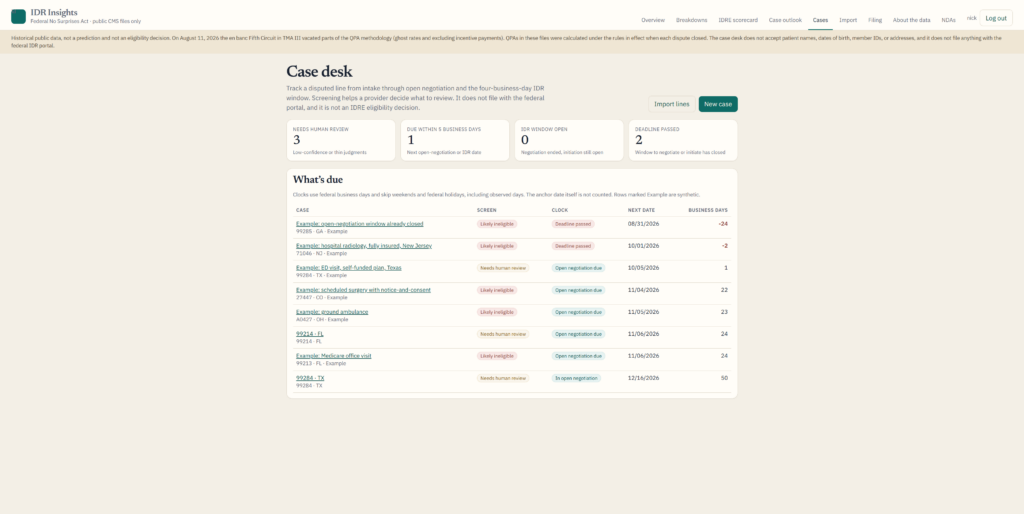
- Automatic deadline calculation in federal business days from your anchor date for open negotiation, IDR initiation, entity selection and offer submission.
- Built-in CMS and NUBC code sets: place of service, HCPCS codes and modifiers, bill types and revenue codes, plus CPT format checks.
- Date and price validation that catches problems before they become ineligibility findings.
- Forms that keep your work when a validation error appears.
- Batching and bulk import from CSV or Excel, with batch suggestions that follow federal rules.
- Case tracking for every open dispute, its status and its next deadline.
- Outcome insights from CMS public use files: historical win rates and typical prevailing offers relative to the QPA by service code, state and certified IDR entity.
Join the IDR Insight AI pilot
We’re looking for a few pilot partners to help us get IDR Insight AI up and running in real-world workflows. It’s a good fit if you’re an independent or specialty practice, a medical billing company or a revenue cycle management firm handling out-of-network claims.
What pilot partners get:
- Early access to IDR Insight AI before general release
- Hands-on onboarding and setup by our team
- Direct input on the product roadmap
- Founding-partner pricing, set together with us
What we ask in return:
- Real out-of-network dispute volume to run through the tool
- Honest, regular feedback on what works and what doesn’t
Ready to talk? Contact Nick Nguyen at ITS: call (949) 446-1716 or email its@InternetTechnologyServices.com. You can also request access at idr.internettechnologyservices.com.
Note: IDR Insight AI is a software tool, not legal advice. Consult qualified counsel about your specific disputes.
Sources: GAO-24-106335; CMS, Independent Dispute Resolution Reports; CMS, Supplemental Background on the Federal IDR PUF, July 1 – December 31, 2025; Georgetown CHIR, Aug. 2026; Medical Economics, Aug. 27, 2026; Holland & Hart, June 26, 2026; CMS IDR fee final rule fact sheet; CMS list of certified IDR entities; HaloMD–Nutex agreement (SEC); First Amendment to HaloMD–Nutex agreement; Claims Assassins; Sydra.
The .com Boom Was the Warm-Up. AI Is the Real Earthquake.

Between January 1995 and March 2000, the Nasdaq went from 751 to 5,048 — a 572% run in five years. Then it crashed, wiping out $5 trillion in market value. The companies that survived weren’t the smartest. They were the ones that acted early and built something useful before the crowd figured out what was happening.
You already lived through that lesson. The AI shift is the same wave, only faster. OpenAI launched ChatGPT in late 2022. By November 2025, 88% of organizations reported using AI in at least one business function, according to McKinsey’s State of AI survey. The difference between .com and AI is speed. The Nasdaq gave skeptics five years to “wait and see.” AI is giving them eighteen months.
What This Looks Like for a Small Business Owner
Forget enterprise case studies. Here’s what AI does for a business with 1 to 20 employees, the kind where the owner is also the sales rep, the bookkeeper, and the one answering the phone:
- Stop missing calls after 5 PM. A human-sounding AI receptionist picks up, books appointments, and answers common questions 24/7. Average local business: 15 to 30 extra leads captured a month just from calls that used to go to voicemail.
None of this is future stuff. Businesses in your area are doing it right now. The owners who figure this out first are building a lead their competitors won’t see coming.
How We Help —
Most AI advice is generic. “Use AI to save time” is the kind of sentence that helps no one. What actually moves the needle is providing you with tools that you apply to your actual day to day. In conjunction with our extensive expierence as a business owner, we get it.
That’s what our AI consultation looks like. We get on a Zoom call, and we walk through a normal day in your business with you:
- The emails you send over and over. We can automate it.
- The spreadsheet you update every Friday. We’ll show you a tool that does it in 2 minutes.
- The phone calls you miss or would rather ignore. We’ll set up an AI receptionist that even sounds like you to take care of the call.
- Stack of resumes to piling up. We can have AI go through it, and provide you with a run down.
- Stop spending hours Monitoring Markets for change indicators, AI will notify you instead.
By the end of the call you have at least three concrete automations you could apply in your day to day. Not a 40-page slide deck. Not a list of “things you could do.” Things that can be done.
If we don’t find anything worth automating, we’ll tell you that too. We don’t take a project just to bill.
The Math Is Simple
The .com boom separated the businesses that saw the wave from the ones that didn’t. The AI shift is doing the same thing, only faster. McKinsey’s same survey notes that only a small fraction of organizations are “AI high performers” — meaning they’re actually getting measurable business results, not just experimenting.
The gap between “using AI” and “getting a return from AI” is exactly where we work. If you’re a business owner who’s heard enough about AI and just wants someone to get on a call and show you what to do with it, that’s what we do.
Schedule a Zoom consultation and we’ll help you get started
Check your AI visibility
Find out if AI is recommending your site with our free instant scan.
Free scan. Takes ~5 seconds. No credit card.
Introducing Our AI Receptionist — It Talks, Books Appointments, and Never Misses a Call

Most small business owners know the feeling. You’re with a client, on a ladder, or elbows-deep in a job — and your phone rings. By the time you get to it, they’ve hung up. Or worse, they called a competitor who did answer.
The solution has been around for decades: hire a receptionist ($35,000+/year) or use a “virtual receptionist” service. But virtual receptionists were never actually virtual — they were call centers with scripts, hold music, and key-press menus that sent callers into a maze before anyone said a word.
We apply AI to offer something revolutionary.
The Problem With Traditional Virtual Receptionists
If you’ve ever called a business and heard “Press 1 for sales, press 2 for support, press 3 to speak with an operator,” you’ve experienced the old way. Here’s what’s wrong with it:
- Nobody wants to press 1. Key-press menus (IVR systems) have a 50-70% abandonment rate. Half your callers hang up before they ever reach a human.
- Generic and detached. Pre-recorded greetings sound like an airport announcement. They don’t know your business, your services, your pricing, or your availability.
- Expensive call centers. Traditional virtual receptionist services charge per-minute or per-call, and the person answering has never heard of your company. They’re reading a script. Customers can tell.
- 9-to-5 mentality. Most services operate during business hours. If a lead calls at 8 PM on a Saturday — and they will — nobody’s there.
- No booking, cant answer questions A traditional receptionist takes a message. They don’t book the appointment. They cant answer questions.
How Our AI Receptionist Is Different
Our AI receptionist answers the phone like a human. Because it is human-sounding. But it’s also connected, intelligent, and never sleeps.
Are you losing deals because of missed calls?
Check out our human sounding intelligent Phone Receptionist
A human-sounding conversational AI that answers your phone when you can’t, it can even books appointments, or answer questions, and its available 24/7. Never miss a lead again. Try it: (949) 750 8995
Integrates with your existing business phone number
Integration is seamless to your existing business so there is not interruption or changes, you’ll still get your calls, but when you cant answer, instead of voicemail your customers are greeted with our intelligent AI (that can take messages just like your existing voicemail)
It Actually Talks — No Press 1, No Menus
Callers are greeted by a natural, conversational voice. They say what they need — “I need to schedule a furnace inspection” — and the AI understands. It asks the right follow-ups just like a trained receptionist would. There’s no keypad mashing, no “please listen carefully as our options have changed.” Just a conversation.
It can be taught your Business
Our AI can be configured to understand your specific services, pricing, hours, and availability. When someone calls asking “how much does an emergency repair cost?” or “are you open on weekends?” — it answers correctly, consistently, every time. It never has a bad day, never forgets a detail.
It can check your schedule and Books Appointments — Right Into Your Calendar
This is the game-changer. The AI doesn’t just take messages. It checks availability, books the appointment, sends a confirmation text to the customer, and alerts you. No back-and-forth emails. No missed calendar entries. The call becomes a booked job, automatically.
24/7, Holidays, Weekends, Always
Leads don’t only call between 9 and 5. The Tuesday evening emergency call, the Saturday morning inquiry, the holiday weekend lead — our AI answers every single one. Your voicemail never picks up again
Traditional Receptionist vs. AI Receptionist
| Feature | Traditional Virtual Receptionist | Our AI Receptionist |
|---|---|---|
| Greeting | “Press 1 for sales…” | Natural conversation |
| Call abandonment | 50-70% hang up | Near zero |
| Business knowledge | Scripted, generic | Configured to your exact services & pricing |
| Books appointments | Rarely — takes messages | ✓Can Book into your calendar live |
| Availability | Business hours | 24/7/365 |
| Dynamically Transfer calls | Requires keypad press | Intelligently determined no key press required |
| Cost | $200-$800/month | Starts at $499 setup + $149/month |
| Setup time | Days to weeks | ~2 days |
Who Is This For?
Any business that gets phone calls and can’t answer every single one. We’ve set this up for:
- Home services — plumbers, electricians, HVAC contractors, roofers, landscapers
- Professional services — law firms, accountants, real estate agents, consultants
- Healthcare — dentists, chiropractors, physical therapists
- Auto shops — mechanics, body shops, detailers
- Restaurants & hospitality — reservations, catering inquiries, event bookings
If a missed call means a missed paycheck, this pays for itself the first week.
Try It Yourself — Right Now
We set up a live demo so you can hear exactly what your customers would hear. Call our demo plumbing company and book an appointment:
(949) 750-8995 — Call the Demo Now
You’ll hear the AI answer, ask about your plumbing needs, check availability, and book an appointment. It sounds so natural most people don’t realize they’re talking to artificial intelligence — they just know their problem got handled.
Simple Pricing, No Surprises
One-time setup starting at
$499
starting at $149/month
Takes ~2 days to get live. No contracts. Cancel anytime.
A full-time receptionist in Orange County costs $35,000-50,000/year. A traditional call-answering service runs $200-800/month and still can’t book appointments. Our AI receptionist costs a fraction and works harder than any of them.
Ready to Stop Missing Calls?
Every missed call is revenue you’ll never see. The businesses that answer — every time, any time — are the ones that win. Let’s get yours set up.
Call (949) 446-1716 or email Its@InternetTechnologyServices.com to get started. Or call the demo line above and hear it for yourself first and the demo will transfer you to us upon completion.
Why Your AI Gives Inconsistent Answers (And It Is Not What You Think)

You ran the same query twice. Same question. Same customer. Different answer.
You probably blamed the AI. Or the model having a bad day. Or randomness.
Here is what is actually happening: the AI did not change. Your prompt did.
Not the words — the formatting. A space here. A newline there. A period instead of a colon. These seem like nothing. To the AI, they are everything.
What Tokenization Drift Actually Means
Before an AI model processes any text, it converts that text into numbers — token IDs. The same words, formatted differently, produce completely different token sequences.
Here is a real example from the GPT-2 tokenizer (the same scheme used by GPT-4, LLaMA, and Mistral):
The word “classify” with a leading space becomes token [36509]. Without the space, it becomes tokens [4871, 1958] — two tokens instead of one, completely different numbers.
To the model, ” classify” and “classify” are as different as “apple” and “orange.”
Now think about what happens when your AI customer service prompt has a leading space in one interaction and not in another. Or when one query ends with a period and the next ends with nothing. The model is not being inconsistent — it is receiving completely different inputs.
Why This Matters for Your Business
When you fine-tune an AI for your business — say, an AI receptionist that handles calls and books appointments — you are not just training it on tasks. You are training it on the specific format, structure, and phrasing of how those tasks are presented.
If your production prompts deviate from that trained format, you are sending the model inputs it was never optimized to handle. It will still try to answer. It just will not answer as well.
This is why many AI implementations work in demos and fail in production. The demo uses clean, consistent formatting. Production involves messy, variable inputs — different employees using slightly different phrasings, API calls arriving in different formats, real-world customer messages that do not match the training data.
The Fix Is Simpler Than You Think
You do not need a better model. You need consistent formatting.
Lock down your prompt templates. Use the exact same structure every time: same spacing, same separators, same capitalization patterns. Test your prompts the way you would test any other piece of business software — with consistency in mind.
If you are using an AI receptionist or any customer-facing AI system, the format of your prompts matters as much as the content. Do not let sloppy formatting undermine what your AI was trained to do.
If you are building or running AI-powered customer service — an AI receptionist that handles calls, checks your schedule, and books appointments automatically — the consistency of your prompts is not a technical detail. It is the difference between a system that works in demos and one that works every time a customer calls.
AI Outperformed Doctors in a Harvard Study. What That Means for Your Business.

A new Harvard study published in Science made headlines this week: OpenAIs o1 model outperformed two physicians in emergency room triage diagnoses. The AI got the exact or close diagnosis in 67% of cases. The physicians: 55% and 50%.
Before you assume AI is coming for your doctors job — or your job — read the fine print. And then think about what this actually means for how you run a business.
What the Study Actually Tested
The researchers tested AI against internal medicine physicians at Beth Israel Deaconess Medical Center, using real emergency room cases. The AI was given exactly the same information from electronic medical records that the doctors had at the time of each diagnosis.
At the first triage touchpoint — when there is the least information and the most urgency — o1 performed best. That is also, not coincidentally, where most business AI systems fail most often: incomplete information, high stakes, time pressure.
The researchers were careful to note that AI is not ready to make real life-or-death decisions without clinical trials. And an emergency physician quoted in the coverage made a fair point: comparing a language model to an internal medicine doctor on ER cases is not quite an apples-to-apples comparison. ER physicians are specifically trained for that environment.
The Point for Your Business
You are not running an emergency room. But you are probably running a business where speed and consistency in decision-making matter.
Here is what is worth taking away: AI is no longer just matching human performance on simple tasks. In structured, information-rich environments — where the inputs are clear and the output formats are well-defined — AI is starting to beat experienced humans.
That is exactly the profile of a well-designed AI customer service system: a receptionist that handles calls, checks your schedule, books appointments, answers common questions. Structured input. Structured output. High volume. Repetitive enough that consistency matters.
The study also reinforces something practitioners already know: the AI is only as good as the information it receives. The Harvard researchers emphasized they did not pre-process the data at all — they gave the AI exactly what was in the medical records. When the information was complete and well-structured, the AI performed at its best.
For your AI systems, that means getting your data, your prompts, and your workflows structured properly is not optional. It is the actual competitive advantage.
The Caveat Is Real
Nobody is saying AI should be making your hardest decisions without human oversight. The Harvard researchers called for clinical trials. The emergency physician flagged the comparison framing. They are right to be careful.
But for routine, high-volume business tasks — answering phones, scheduling appointments, handling common customer questions — the evidence is getting harder to ignore. AI is good enough now. The question is whether your business is set up to use it.
If you are looking to put this kind of AI capability to work in your business — an AI receptionist that handles calls, checks your schedule, and books appointments automatically — the technology is proven. The difference is in the setup. That is where someone who knows how to do it right makes all the difference.
Why Your AI Prompts Keep Failing (And How to Fix Them)

Most people write AI prompts like this: type something reasonable, hit send, see what comes out, try again if it does not work. Maybe a few times. Eventually you get something usable.
That approach works fine when AI is a novelty. It is a problem when AI is running parts of your business.
The uncomfortable truth: most AI reliability problems are not the AI. They are the prompts. And prompts are fixable without changing models, spending more money, or upgrading your infrastructure.
The research community has formalized a set of prompting techniques that move AI from usually working to consistently working. Here are the ones that actually matter for business applications.
1. Role-Specific Prompting
Instead of asking a generic question, tell the AI who to be. Not just a job title — a perspective, a set of constraints, a way of thinking.
Generic: Write an email to a customer about a delay.
Role-specific: You are a customer support specialist at a small logistics company. Write an email to a B2B customer whose shipment is three days late. Be direct, take responsibility, offer a concrete solution.
The second version almost always produces something more useful. The role constrains the AI to a specific mindset rather than defaulting to generic helpfulness.
2. Negative Prompting
Tell the AI what NOT to do. Specific constraints, not vague warnings.
Instead of: Write a product description.
Try: Write a product description for a handyman service. Do not use the words reliable, professional, or quality. Do not make promises you cannot verify. Do not use exclamation points.
The second version forces specificity. Generic AI outputs are usually a symptom of never telling the AI what to avoid.
3. Structured JSON Outputs
If you are using AI to power an application — an AI receptionist, a data extraction tool, a scheduling system — you need the output in a specific format. Not prose. Not a list. JSON.
The trick is being explicit about the structure in the prompt itself. Tell the AI exactly what keys you expect, what types of values, and what the constraints are. When you specify the output structure, the AI has far less room to wander.
For an AI receptionist, this might look like asking for: customer name, appointment date, appointment time, service type, and a confirmation status. The AI fills those slots. Your system receives clean, usable data.
4. Attentive Reasoning Queries (ARQ)
This technique gets the AI to pay attention to what you actually asked, rather than what it assumes you meant. You prompt it to restate your question back, identify ambiguities, and confirm understanding before responding.
For business applications, this cuts down on one of the most common failure modes: the AI giving you a confident answer to a question you did not ask.
5. Verbalized Sampling
Generate multiple possible responses, then have the AI reason through which one is best before presenting it. Instead of one output, you get several considered options.
In practice, this looks like asking the AI to generate two or three responses, then evaluate them against your specific criteria, then return the best one. More upfront work, but significantly better outputs for high-stakes tasks.
The Pattern
These techniques share a common thread: they treat AI output as an engineering problem, not a magic problem. You are not hoping the AI feels inspired. You are designing the inputs to constrain the outputs toward what you actually need.
For small businesses running AI in customer-facing applications, these techniques are not optional. They are the difference between AI that works in demos and AI that works in production.
If you are interested in integrating AI, we can help.
The Ultimate Guide to Integrating AI with Cloud Services for Businesses

AI and cloud technologies have become the dynamic duo powering today’s business landscape. When combined, they don’t just add value—they multiply it, creating a catalyst for breakthrough innovation, streamlined operations, and rapid growth.
Here’s a closer look at why this partnership is so impactful, how you can make it work for your organization, and the steps to kick things off.
What Makes AI + Cloud a Game Changer?
In a nutshell: adaptability, scalability, and cost-effectiveness.
In more detail: You’re able to sift through enormous volumes of information, launch intelligent applications, and pivot as your business evolves—all without draining your resources.
Major cloud providers like AWS, Azure, and Google Cloud deliver the infrastructure muscle. AI injects the intelligence. Together, they empower you to:
- Process and interpret data instantly.
- Streamline repetitive workflows.
- Deliver tailored experiences to every customer.
- Anticipate market shifts before your rivals catch on.
Still running AI on outdated, in-house hardware? Now’s the time to modernize.
Top Ways Businesses Are Using AI in the Cloud
1. Enhanced Customer Support
Roll out chatbots and digital assistants that truly “get” your customers. Forget the generic “Can you repeat that?”—today’s AI-driven agents learn and adapt over time.
We craft bespoke conversational AI solutions to boost your customer interactions.
2. Smarter Marketing Decisions
Cloud-based AI can analyze your marketing campaigns, uncover trends, and suggest your next winning move. Want to climb the SEO ladder with AI-powered insights?
Our SEO specialists can help you rise through the ranks.
3. Predictive Equipment Management
In manufacturing and logistics, AI forecasts when machines might fail—helping you avoid costly downtime and keep things running smoothly. Your finance team will appreciate the savings.
4. Customized Digital Experiences
AI personalizes app content and features for each user, while cloud hosting ensures your platform can handle spikes in traffic—so you’re ready when your product goes viral.
We build web applications and mobile apps for iOS and Android designed for seamless AI integration.
Your Step-by-Step Guide to AI-Cloud Integration
1. Pinpoint Your Business Challenges
Don’t adopt AI just because it’s the latest trend. Figure out where your pain points lie. Is it customer service bottlenecks? Data overload? App sluggishness?
2. Pick the Best Cloud Platform
AWS, Azure, and Google Cloud all offer powerful AI features. Choose the one that aligns with your existing systems and budget. Need help with setup or ongoing management?
We handle cloud infrastructure so you can focus on your business.
3. Select the Right AI Tools
Whether you need language understanding, image recognition, or something else, there’s an AI solution out there. Start with a focused pilot rather than trying to overhaul everything at once.
4. Connect AI to Your Applications
From WordPress sites to custom-built apps, integration is essential.
Our WordPress experts can create custom themes and plugins that work seamlessly with AI APIs.
5. Keep Improving
AI isn’t a “set it and walk away” solution. Monitor outcomes, gather user feedback, and refine your approach. The cloud makes it simple to adjust resources as your needs shift.
Watch Out for These Common Hurdles
- Data Protection: Storing data in the cloud means trusting a third party. Encrypt sensitive information and enforce strict access policies.
- Integration Pains: Legacy systems may not mesh easily with cloud-based AI. Be prepared to implement middleware or custom APIs—and expect a learning curve.
- Budget Surprises: Pay-as-you-go models are flexible, but costs can escalate quickly if left unchecked. Set clear spending limits and track usage closely.
Expert Tips for Effortless Integration
- Define clear objectives. “Let’s try AI” isn’t a plan—identify what you want to achieve.
- Prioritize training. Equip your team with the know-how to navigate both AI and cloud environments.
- Automate strategically. Delegate repetitive tasks to AI, freeing up your people for higher-value work.
- Plan for SEO from the start. AI can personalize content and boost your search visibility, but only if it’s part of your digital roadmap.
Let our SEO professionals help you build a solid foundation.
Wrapping Up
Bringing AI and cloud services together isn’t reserved for tech behemoths. With the right strategy, any business can deliver smarter solutions, delight customers, and sharpen its competitive edge.
Looking for a partner fluent in both AI and cloud technologies?
Check out our comprehensive development and integration offerings.
AI Chatbots for WordPress: Enhancing Customer Support on Your Business Site

Today’s customers expect immediate attention. They’re not interested in waiting around—whether it’s a question at noon or a request in the middle of the night, they want answers right away. That’s where AI chatbots for WordPress step in: always available, never needing a break, and unfailingly polite.
The Case for AI Chatbots on Your WordPress Platform
Think of your website as the welcome mat to your business. If you’re using WordPress, you’re in good company—nearly half the internet relies on it. Yet, even the most visually appealing site can leave visitors frustrated if support isn’t readily accessible.
AI chatbots fill this gap seamlessly. They greet guests, resolve queries, and guide people through your site—all in real time. The result? Fewer missed opportunities, less customer frustration, and round-the-clock assistance.
More Than a Trend: The Real Value of AI Chatbots
AI chatbots aren’t just decorative features; they’re powerful business tools. Here’s what sets them apart:
- Immediate Assistance: People dislike waiting. Chatbots provide instant replies, keeping users engaged and satisfied.
- Effortless Scalability: Whether your site sees a handful of visitors or thousands at once, chatbots manage the influx with ease.
- Cost Savings: By automating everyday questions, your human team can focus on more complex requests.
- Actionable Insights: Every conversation is a source of valuable information—revealing customer needs, common obstacles, and opportunities for improvement.
Transforming Customer Support with AI
Picture this: a visitor arrives on your site at 2 a.m., searching for product details. Your chatbot is there, ready to help. It can:
- Address common questions (shipping, returns, pricing, and more)
- Direct users to relevant pages or products
- Collect contact information for future follow-up
- Escalate more complicated issues to a real person when needed
The outcome? More satisfied customers and increased conversions. It’s like having your top support agent available at all hours.
Integration Is Simpler Than You Think
Worried that adding AI to your WordPress site will be complicated? There’s no need. Today’s chatbots are designed for straightforward setup, often through plugins or quick code snippets. You don’t need to be a tech expert. Of course, if you’re aiming for a tailored solution, our WordPress specialists can help you create, deploy, and manage a chatbot that truly reflects your brand.
Beyond Support: SEO Benefits and Data Insights
Here’s an added perk: chatbots can give your SEO a lift. By keeping visitors engaged and lowering bounce rates, your site’s search rankings can improve. When users quickly find what they need, they’re more likely to stick around—something search engines appreciate.
Chatbots also collect a wealth of data. Curious about which products generate the most questions? Or where users tend to get lost? Your chatbot tracks it all, helping you fine-tune your site and content. If you want to turn these insights into higher search visibility, our SEO experts are ready to assist.
Cloud-Based Chatbots: Speed, Reliability, and Security
Performance is crucial. A sluggish or unreliable chatbot can do more harm than good. That’s why many businesses are shifting to cloud-hosted AI chatbots. Cloud solutions deliver:
- Rapid response times
- Consistent uptime—no more unexpected outages
- Effortless scalability as your audience grows
Need help setting up or maintaining cloud infrastructure for your chatbot? Our cloud services team is here to support you.
Custom AI Chatbots: Tailored for Your Business
While standard chatbots are great for basic inquiries, sometimes you need more. If you want a chatbot that understands your unique business, products, and customers, custom conversational AI is the answer.
Custom AI chatbots can:
- Sync with your CRM, inventory, or booking tools
- Navigate complex, multi-step conversations
- Communicate in your brand’s distinctive voice
Interested in a chatbot that’s as individual as your company? Explore our custom conversational AI solutions.
Chatbots for Every Device: Desktop, Tablet, and Mobile
Your audience isn’t limited to desktop computers—they’re browsing on smartphones and tablets, too. A well-designed chatbot works flawlessly across all devices. If you’re considering a mobile app with integrated AI support, our mobile development team can help bring your ideas to life.
Final Thoughts
AI chatbots for WordPress have moved from being a luxury to a necessity for businesses aiming to deliver top-notch customer service. They enhance satisfaction, streamline operations, and enable you to grow without sacrificing quality. Whether you’re looking for a straightforward plugin or a fully customized solution, having the right partner makes all the difference.
Ready to upgrade your WordPress site with AI? From web development and SEO to cloud solutions and bespoke AI, we’re here to help. Because your customers deserve support that’s always available—and your business deserves every opportunity to thrive.
The Benefits of Implementing AI-Powered Customer Support in Your Business

In today’s fast-paced digital world, customer support is more than just a necessity—it’s a competitive advantage. Enter AI-powered customer support. It’s not just a buzzword; it’s the future. Let’s dive into why integrating AI into your customer service strategy is a game-changer.
24/7 Availability
AI doesn’t sleep. It doesn’t take coffee breaks or call in sick. With AI-powered customer support, your business can offer round-the-clock assistance. Whether it’s midnight or midday, your customers can get the help they need. This constant availability enhances customer satisfaction and loyalty.
Instant Responses
Remember the last time you waited on hold? Painful, right? AI eliminates wait times with instant responses. Customers get their questions answered in seconds, not minutes. This speed not only improves the customer experience but also frees up human agents to tackle more complex issues.
Cost Efficiency
Hiring and training staff is expensive. AI-powered solutions reduce these costs. While initial setup might require investment, the long-term savings are significant. AI can handle multiple inquiries simultaneously, reducing the need for a large support team.
Personalization at Scale
AI doesn’t just respond; it learns. By analyzing customer data, AI can offer personalized recommendations and solutions. Imagine a customer service agent who remembers every interaction you’ve ever had. That’s AI. Personalized service at scale is no longer a dream—it’s a reality.
Consistency and Accuracy
Humans make mistakes. AI? Not so much. AI-powered support ensures consistent and accurate responses. This consistency builds trust with your customers, ensuring they receive the same high-quality service every time they reach out.
Scalability
As your business grows, so do your customer support needs. AI scales effortlessly. Whether you’re a startup or a multinational corporation, AI can handle increased demand without compromising on quality.
Data-Driven Insights
AI doesn’t just interact with customers; it learns from them. By analyzing interactions, AI provides valuable insights into customer behavior and preferences. This data can inform business strategies, product development, and marketing efforts.
Multichannel Support
Today’s customers interact with businesses across multiple platforms—email, chat, social media, and more. AI-powered support can seamlessly integrate across these channels, ensuring a consistent experience no matter where your customers are.

Enhanced Human-Agent Collaboration
AI isn’t here to replace human agents; it’s here to assist them. By handling routine inquiries, AI frees up human agents to focus on complex issues that require a personal touch. This collaboration leads to a more efficient and effective support team.
How We Can Help
Looking to integrate AI into your customer support? Our Custom Conversational AI Agents can elevate your customer engagement. Whether you need a custom solution or want to enhance existing systems, we’re here to help.
Need more than AI? Our Mobile Application Development and Web Application Development services ensure your digital presence is top-notch. And if you’re venturing into the cloud, our Cloud Services have you covered.
Conclusion
AI-powered customer support is not just a trend—it’s a necessity for businesses looking to thrive in the digital age. From cost savings to enhanced customer experiences, the benefits are undeniable. Embrace the future of customer support and watch your business soar.

Leveraging AI for Personalized User Experiences in Web Applications

Remember the days of one-size-fits-all websites? They felt a bit like getting a generic birthday card – nice gesture, but not exactly personal. Today, users expect more. They crave experiences tailored specifically to them. Enter Artificial Intelligence (AI).
AI isn’t just sci-fi anymore. It’s the engine driving truly personalized user experiences in modern web applications. It transforms generic interactions into relevant, engaging journeys.
Why does this matter? Because personalization isn’t just a nice-to-have; it’s a business imperative.
The Power of Personal Touch (Even Digitally)
Generic experiences are forgettable. Personalized ones stick. When a web application understands and anticipates a user’s needs, magic happens:
- Engagement Soars: Users spend more time interacting when content and features resonate.
- Conversions Climb: Relevant recommendations and tailored pathways lead users towards desired actions.
- Loyalty Builds: Feeling understood fosters a stronger connection between the user and the brand.
Think about it: you’re more likely to return to a coffee shop that remembers your usual order. AI helps your web application do the digital equivalent. Ignoring personalization is like serving everyone plain vanilla – safe, but boring.
How AI Weaves the Personalization Magic
AI achieves this through several key capabilities:
-
Mastering the Data Deluge: AI algorithms excel at processing vast amounts of user data – browsing history, click patterns, demographics, past purchases, time spent on pages. This isn’t just collecting data; it’s understanding the story behind it. Of course, handling this data securely and efficiently requires a solid foundation. Reliable Cloud Services are crucial for managing the infrastructure needed for AI-driven insights.
-
Predicting the Future (Sort Of): Based on historical data and patterns, AI uses predictive analytics to anticipate what a user might want or do next. It can forecast preferences, potential churn, or the likelihood of conversion. It’s less crystal ball, more highly educated guess.
-
Smarter Recommendations: This is the classic example. Think Netflix suggesting shows or Amazon recommending products. AI analyzes user behavior and compares it to similar users to suggest relevant content, products, or features within your web application. This keeps users engaged and helps them discover value they might otherwise miss.
-
Dynamic Interfaces: Why should everyone see the exact same layout? AI can subtly adjust the user interface (UI) or user experience (UX) based on individual preferences or behavior. This could mean highlighting certain features, rearranging modules, or simplifying navigation for specific user segments. Building such adaptable interfaces requires skilled developers, whether for complex Web Application Development or creating flexible themes within platforms like WordPress (WordPress Development Services).
-
Personalized Search & Discovery: Generic internal search results can be frustrating. AI can personalize search results within your application, prioritizing information most relevant to the individual user based on their past interactions and profile. This mirrors the principles of good external Search Engine Optimization, focusing on delivering the most relevant results quickly.
-
Intelligent Conversations: AI-powered chatbots and virtual assistants offer instant, personalized support 24/7. They can access user history to provide relevant answers, guide users through processes, and even handle transactions – all in a conversational manner. Need a chatbot that truly understands your customers? Explore Custom Conversational AI Agents.
Personalization in Action
Let’s look at some examples:
- E-commerce: Suggesting complementary products (“Customers who bought this also liked…”), personalized promotions, or even dynamically adjusting product displays based on browsing history.
- Content Platforms: Curating news feeds, recommending articles or videos based on reading/viewing habits. Many successful content sites rely on robust platforms and custom features, often built through expert WordPress Development Services.
- SaaS Applications: Offering personalized onboarding flows, highlighting relevant features based on user roles or usage patterns, and providing proactive tips. This level of sophistication is a hallmark of well-executed Web Application Development.
- Mobile Experiences: Extending personalization seamlessly to handheld devices, using location data (with permission!) or app usage patterns for tailored notifications and content. This requires dedicated focus during Mobile Application Development.
Ready to Get Personal?
Implementing AI personalization doesn’t have to be an overwhelming overhaul.
- Start Focused: Identify 1-2 key areas where personalization could have the biggest impact on your user experience and business goals.
- Data is Your Foundation: Ensure you have clean, accessible, and ethically sourced user data. Robust data management, often supported by scalable Cloud Services, is non-negotiable.
- Choose the Right Tools & Partners: Select AI tools and platforms that fit your needs and technical capabilities. Often, integrating these tools effectively requires expertise in Web Application Development or specific AI integrations.
- Iterate and Refine: AI personalization is not a set-it-and-forget-it solution. Continuously monitor results, gather feedback, and refine your algorithms.
The Future is Tailored
AI-driven personalization is rapidly shifting from a competitive advantage to a baseline expectation. Users increasingly expect digital experiences that understand and adapt to them. By leveraging AI, you can move beyond generic interactions and build web applications that feel intuitive, relevant, and genuinely helpful.
Ready to explore how AI can transform your user experience? Whether it’s building intelligent web applications, deploying custom AI agents, or ensuring your cloud infrastructure is ready, we can help.
5 Reasons Why You Should Integrate AI in 2025
The AI Revolution: Why Your Business Can’t Afford to Wait in 2025
It’s 2025, and Artificial Intelligence (AI) is no longer just a futuristic concept – it’s actively revolutionizing business success across industries. Beyond being merely an IT trend, AI has emerged as a transformative force driving operational efficiency, fostering innovation, and accelerating strategic growth. According to recent reports like those highlighted by Forbes, a significant 72% of businesses now report using AI in at least one of their functions, representing a massive leap forward from adoption rates just a couple of years prior in 2023.
Here’s a deeper look at the compelling reasons why adopting AI today is not just beneficial, but crucial for the sustained success and competitiveness of your business:
1. Staying Ahead of Competitors
In an increasingly crowded marketplace, early adopters of AI are already establishing clear leadership positions. They are leveraging AI to develop innovative new products and services, optimize existing offerings, and personalize customer experiences in ways that were previously impossible. Sectors such as healthcare, finance, and transportation, among others, are witnessing particularly transformative applications of AI that are reshaping their fundamental operations and service delivery.
2. Meeting Heightened Customer Expectations Through Personalization
Modern customers expect highly personalized interactions and tailored experiences. AI is uniquely positioned to meet these demands by analyzing vast amounts of customer data to understand individual preferences and behaviors. This enables businesses to offer smarter product recommendations, provide real-time support through AI-driven chatbots, and deliver truly customized experiences across all touchpoints. This level of personalization significantly boosts customer satisfaction, fosters deeper loyalty, and drives repeat business.
3. Growing Accessibility for Businesses of All Sizes
What was once considered a prohibitively expensive luxury accessible only to large corporations is now increasingly within reach for businesses of all sizes. Major tech providers are offering scalable AI solutions and cloud-based platforms that democratize access to AI capabilities. Furthermore, the proliferation of pre-built AI models and a wealth of open-source tools mean that even small and medium-sized businesses can begin to leverage powerful AI technologies without requiring massive initial investments or extensive in-house expertise.
4. Expanding Business Opportunities and Offerings
AI acts as a catalyst for innovation, paving the way for entirely new products, services, and opportunities to enter new markets. From enabling advanced diagnostics and personalized treatment plans in healthcare to powering autonomous vehicles and optimizing complex logistical networks, the potential applications of AI are vast and continue to expand rapidly. Integrating AI can unlock untapped potential and create entirely new revenue streams for your business.
5. Enhancing Operational Efficiency
AI, particularly through machine learning, significantly improves decision-making accuracy by identifying complex patterns and accurately predicting market trends, customer demand, or potential operational bottlenecks. Natural Language Processing (NLP) enhances customer interactions by automating support, analyzing feedback, and personalizing communication. AI can streamline and simplify complex operations across virtually all sectors, from optimizing supply chains in manufacturing to improving patient care workflows in healthcare and managing traffic flow in transportation.
6. BONUS Improving Decision-Making with Data-Driven Insights
In the age of big data, the ability to extract meaningful, actionable insights is paramount. AI excels at processing and analyzing massive datasets far beyond human capacity. This capability drives more informed, strategic, and timely decision-making across all facets of the business, including operations, marketing, finance, and product development. Moving from intuition or limited data to AI-powered insights provides a significant competitive advantage.
The message is clear: the time to integrate AI into your business strategy is now. Don’t risk getting left behind in the wake of rapid technological advancement. Embracing AI is key to staying competitive, meeting the rising expectations of your customers, optimizing your operations, and exploring exciting new avenues for growth and innovation.
AI is Your New Super-Employee

AI is Your New Super-Employee (and It Works for Peanuts!)
Running a small business can often feel like juggling flaming chainsaws while riding a unicycle – you’re constantly busy and stretched thin. What if there was a way to get significant help without the overhead of hiring another full-time person?
Enter AI.
AI: Not Just for Sci-Fi Anymore
Forget the visions of robots taking over the world (at least for business purposes!). AI, in its current practical form, is a powerful set of tools that can seriously boost the efficiency and capabilities of your small business. Let’s explore some concrete ways you can leverage AI right now.
Sales Chatbots: Your 24/7 Sales Team
Imagine a salesperson who never sleeps, never takes a break, and never asks for a raise. That’s the power of an AI Sales Chatbot integrated into your website.
- Feature: Responds instantly to website inquiries, day or night.
- Benefit: Captures leads effectively and answers initial questions around the clock, significantly increasing the chances of turning potential website visitors into paying customers.
Customer Service Chatbots: Happy Customers, Less Stress
Are you tired of spending valuable time repeatedly answering the same common questions from customers? An AI Customer Service Chatbot can expertly handle it for you.
- Feature: Provides instant, accurate answers to frequently asked questions.
- Benefit: Frees up your time and your team’s time to focus on more complex or strategic tasks, while keeping your customers satisfied with immediate support.
Automation: Kiss Tedious Tasks Goodbye
AI excels at performing repetitive, rule-based tasks with speed and accuracy. Think about automating processes like scheduling appointments, sending personalized follow-up emails, and even data entry into your CRM or other systems.
- Feature: Automates various workflows and routine tasks.
- Benefit: Saves you significant time, reduces the likelihood of human error, and allows you to dedicate your energy to core activities that drive business growth.
Content Creation: Your New Secret Weapon
Struggling to consistently come up with fresh, engaging content for your blog, social media, or email newsletters? AI can be a powerful assistant in the content creation process.
- Feature: Generates drafts of unique and engaging content ideas or even full pieces.
- Benefit: Helps you maintain a consistent content flow, keeps your audience engaged, supports your SEO efforts, and helps establish your brand as an authority in your industry.
AI Agents: Your Virtual Assistants on Steroids
Think of AI agents as highly specialized, super-powered virtual assistants that can be trained to handle a wide array of tasks, from conducting online research and summarizing information to assisting with project management or analyzing data.
- Feature: Can be customized and trained to handle specific tasks unique to the needs and workflows of your business.
- Benefit: Provides tailored support, automates complex or multi-step processes, and helps further streamline your overall operations.
Ready to Unleash the Power of AI?
AI is not some far-off futuristic concept confined to science fiction. It is a practical, accessible, and powerful tool that can help your small business not just survive, but truly thrive today.
Ready to explore concrete ways AI can transform your specific business operations, improve customer interactions, and free up your valuable time? Get in touch with us, and let’s have a conversation about how we can effectively make AI work for you!